
Dental Implant vs. Bridge: Which Is the Best Choice for Your Smile in 2026?
The lower-cost choice today may ask more of your smile over time. In the dental implant vs bridge decision, a bridge fills the gap by relying on neighboring teeth, while an implant replaces the missing tooth’s root and supports a separate crown. That difference affects how each option is planned, cleaned, and supported.
If surgery feels intimidating or the long-term costs seem hard to compare, you’re not alone. A bridge may involve a simpler process and lower upfront expense, while an implant requires a surgical procedure and careful planning. The right fit depends on your oral health, comfort, budget, timeline, and priorities.
This guide compares how each treatment works, what to expect during care, and how maintenance and possible replacement can affect long-term value. You’ll also learn how 3D imaging can support implant planning and which questions to bring to a personalized evaluation. Reston Family Dental Center provides restorative care for patients in Reston, Great Falls, Ashburn, Chantilly, Herndon, and Vienna, with treatment recommendations based on each patient’s needs.
Key Takeaways
- The dental implant vs bridge comparison involves more than the initial procedure; consider how each option may affect nearby teeth and the jawbone.
- Implants replace a missing tooth’s root, while bridges use neighboring teeth for support. That difference affects treatment and cleaning.
- Bone density, gum health, the condition of nearby teeth, and personal habits can influence which treatment may suit your needs.
- Compare upfront expense with maintenance and possible repair or replacement needs to understand long-term value.
- 3D imaging can support implant planning, while an individual evaluation helps determine whether an implant or bridge fits your situation.
Understanding Tooth Replacement: The Consequences of Missing Teeth
A gap in your smile can affect more than appearance. Teeth work together to support your bite, guide chewing, and help you form clear speech. When one goes missing, nearby teeth and the jawbone beneath it can gradually change. These changes may affect your bite and the options available for replacing the tooth.
One possible change is super-eruption: the tooth opposite the gap may slowly move out of its normal position because it no longer meets a tooth when you bite. Neighboring teeth can also tilt or drift toward the open space. These shifts may alter how your teeth fit together and make the area harder to clean.
The missing tooth’s root matters, too. Natural roots transmit chewing forces to the alveolar bone, the ridge of jawbone that holds the teeth. Without that stimulation, the bone in the area may gradually shrink. Bone resorption is the body’s process of reabsorbing jawbone mineral when a tooth root is absent. A dental implant replaces a missing tooth’s root as well as its visible crown, while a bridge replaces the visible tooth without replacing the root.
The Functional Impact on Chewing and Speech
Molars do much of the work of grinding food into smaller pieces before you swallow. A gap in that region can make chewing less efficient, so you may favor one side or avoid foods that are difficult to break down. Comfortable, effective chewing helps prepare food for swallowing.
Missing front teeth can affect speech because the tongue and lips rely on contact with the teeth to form certain sounds, including “s” and “f.” Relying more heavily on the remaining teeth can also concentrate biting forces in fewer places. Over time, extra stress may contribute to uneven wear or damage such as chips and cracks.
The Aesthetic Shift: Facial Structure and Aging
Tooth loss can change the way your smile looks, and bone loss may affect the support beneath the lips and cheeks. The effect is more noticeable when several teeth are missing or bone loss has progressed; the lower face may appear less supported or more sunken. Replacing missing teeth can restore the visible contour of your smile, though the right approach depends on which teeth are absent and the condition of the surrounding bone.
There’s also the personal side. If a gap makes you hide your smile or feel self-conscious when speaking, a carefully planned restoration can help you feel more at ease. Understanding how a missing tooth affects your bite, bone, and confidence is a useful first step in weighing dental implant vs bridge options. Reston Family Dental Center provides restorative care for patients in Reston, Great Falls, Ashburn, Chantilly, Herndon, and Vienna.
Dental Implants vs. Bridges: Mechanical and Biological Differences
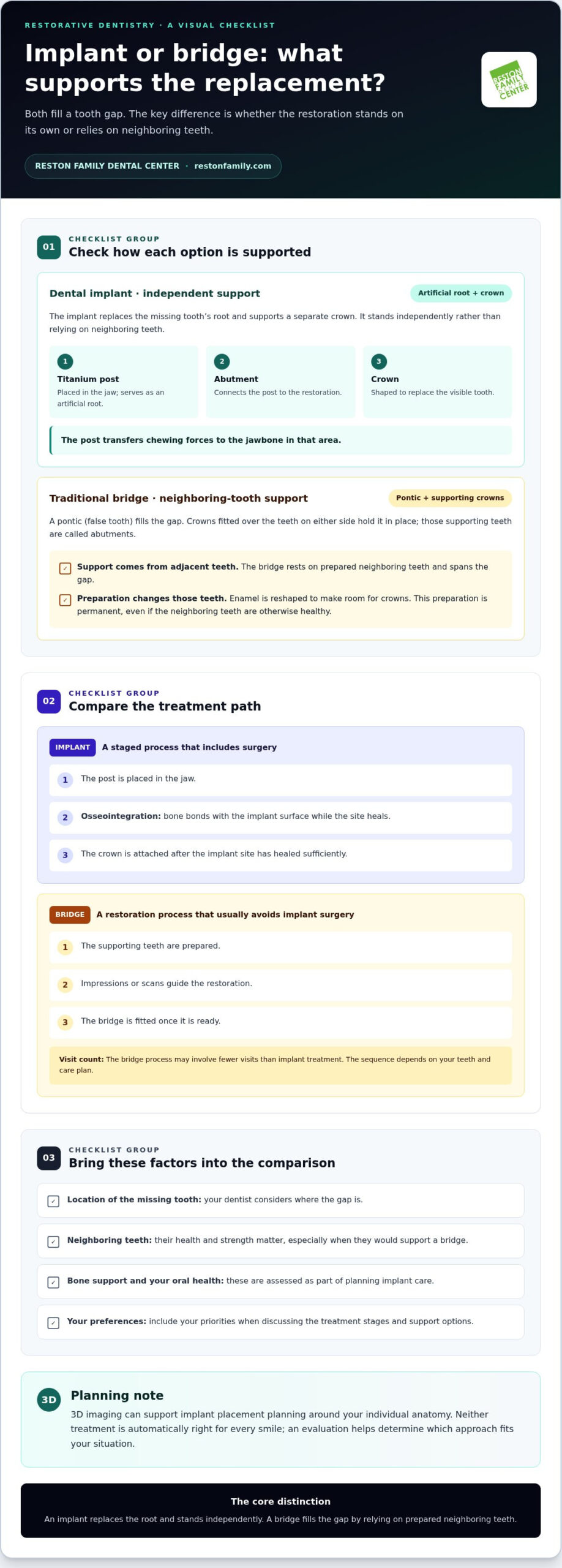
The central difference in the dental implant vs bridge comparison is how each restoration is supported. A dental implant typically has three parts: a titanium post placed in the jaw, an abutment that connects the post to the restoration, and a crown shaped to replace the visible tooth. The post serves as an artificial root, so the replacement stands independently rather than relying on neighboring teeth.
A traditional bridge fills the gap with a pontic, or false tooth, held in place by crowns fitted over the teeth on either side. Those supporting teeth are called abutments. To make room for the crowns, the dentist must reshape their enamel. That preparation is permanent, even if the neighboring teeth are otherwise healthy. A bridge can be a suitable option, but it relies on those teeth for support.
The Procedure: Surgery vs. Restoration
Implant treatment involves placing the post in the jaw, then allowing time for osseointegration, the process in which bone bonds with the implant surface. The crown is attached after the implant site has healed sufficiently, so treatment takes place in stages. Reston Family Dental Center uses 3D imaging to plan implant placement around your individual anatomy and inform treatment planning.
A bridge usually avoids implant surgery. The supporting teeth are prepared, impressions or scans guide the restoration, and the bridge is fitted once it’s ready. The process may involve fewer visits than implant treatment, although the sequence depends on your teeth and care plan. For an overview of implant surgery and what it involves, see the Mayo Clinic on Dental Implants.
Structural Support and Everyday Stability
An implant’s post replaces the missing root and transfers chewing forces to the jawbone in that area. Because it’s a stand-alone restoration, it doesn’t require crowns on adjacent teeth. A bridge, by contrast, rests on prepared neighboring teeth and spans the gap. It can feel stable during everyday use, but its support depends on the condition and strength of those abutment teeth.
Neither option is automatically right for every smile. Your dentist considers the missing tooth’s location, the health of neighboring teeth, bone support, and your preferences. If the implant healing period feels daunting, reviewing the treatment stages can help you weigh the choice. If preserving healthy adjacent teeth is a priority, include that in your restorative planning discussion.
At Reston Family Dental Center, 3D imaging supports implant planning alongside an assessment of your oral health. Learn more about dental implant care in Reston and the factors that inform a treatment plan.
Longevity and Oral Health: The Hidden Impact on Your Jawbone
A restoration’s value isn’t measured only by how long it stays in place. Its effect on the jawbone, gums, and neighboring teeth matters too. An implant’s outcome depends on factors such as the health of the implant site and the care it receives. It isn’t possible to guarantee a particular lifespan. Bridges also need ongoing care and may eventually require repair or replacement.
For a bridge, one reason replacement may become necessary is recurrent decay: bacteria can collect near the edge of a supporting crown, where the restoration meets the natural tooth. If decay develops beneath or around that crown, it can threaten the abutment tooth and compromise the bridge’s support. Implants cannot develop cavities, but the surrounding gums and bone still need careful attention to stay healthy.
Bone Health: The Deciding Factor
Natural tooth roots help stimulate the jawbone during chewing. After a tooth is lost, the bone beneath the gap can gradually resorb. An implant transfers biting forces to the bone around its post, which can help maintain bone in that area. A bridge replaces the visible tooth but doesn’t replace its root, so bone beneath the pontic may continue to change. Implant treatment doesn’t prevent every form of bone loss, and suitability depends on individual health.
Maintaining bone can also matter if you need treatment later. If the jawbone has thinned, additional preparation such as bone grafting may be considered before implant placement. Preserving bone where possible may help limit future treatment needs, but it can’t guarantee that grafting will never be necessary. This biological difference is an important part of the dental implant vs bridge decision.
Maintenance and Hygiene Requirements
Both restorations need daily cleaning and professional monitoring. You can brush around an implant much as you do a natural tooth, while cleaning beneath a bridge’s pontic often calls for a floss threader or another tool designed to reach under the replacement tooth. Your dental team can demonstrate a technique that fits your restoration and help you keep the gumline clean.
Regular preventative dental care in Reston supports both options. At checkups and professional cleanings, the team can assess gum health, look for signs of decay around bridge abutments, and monitor the implant and surrounding tissues. If you notice bleeding, tenderness, a change in your bite, or movement in a restoration, arrange an evaluation rather than waiting for your next routine visit.
Daily habits make a difference. Brush twice daily with a soft-bristled toothbrush, clean between teeth, and follow the personalized instructions you receive for your restoration. Consistent care won’t remove every risk, but it helps your dental team spot changes early and supports the health of your replacement tooth.
Choosing Your Path: Factors from Budget to Bone Density
The best choice depends on more than the missing tooth. Your jawbone and gum health, medical history, timeline, budget, and priorities all shape whether an implant or bridge makes sense. A dental evaluation helps connect those factors to a plan that fits your health and day-to-day life.
For an implant, the dentist assesses whether there’s adequate bone to support placement and whether your gums are healthy. If bone volume is limited, additional treatment may be considered. Smoking can affect healing, so be ready to discuss your habits openly. Certain health conditions or medications may also influence surgical planning. They don’t automatically rule out treatment, but your dentist may need to account for them.
The Financial Breakdown: Initial Cost vs. Lifetime Value
A bridge usually has a lower initial cost, while an implant involves a more involved course of treatment. To compare lifetime value, consider the total cost of the restoration, expected maintenance, and the possibility of repair or replacement. A simple “cost per year” estimate divides projected costs across the years a restoration serves, then accounts for possible future bridge replacements or issues involving supporting teeth. It’s a planning tool, not a guarantee of lifespan or savings.
Insurance can influence the decision in Northern Virginia, but coverage depends on your individual plan. Review benefits for both treatments, including annual limits, waiting periods, deductibles, and any approval requirements. An itemized treatment estimate can make it easier to understand what your plan may contribute and what you may pay yourself. Explore dental implants in Reston as you learn about treatment and plan your next steps.
When a Bridge May Be a Practical Choice
A bridge may be worth discussing if implant surgery isn’t suitable for your health, if bone loss would make implant treatment more complex, or if you prefer to avoid surgery. It can also be considered when restoring the visible gap sooner is a priority, though the exact timeline depends on your individual treatment. Your dentist can explain the trade-offs, including preparation of the neighboring teeth and the bridge’s ongoing care.
Timing matters, but don’t choose based on a hoped-for deadline alone. If you need a restoration before a significant event or work commitment, share that early so your care plan can take it into account. A temporary solution may be discussed when appropriate while your dentist evaluates lasting options.
To compare the choices clearly, bring questions about comfort, treatment stages, insurance, and future maintenance to a personalized evaluation. Reston Family Dental Center provides restorative care and implant planning. Schedule a dental implant evaluation to discuss your oral health, goals, and treatment options.
Advanced Restorative Care at Reston Family Dental Center
Choosing between a dental implant vs bridge is a personal decision, and the care behind that choice should be just as considered as the technology. Reston Family Dental Center brings restorative planning and patient-focused support together. You’ll have room to discuss your concerns, understand the options, and make decisions based on your oral health, priorities, and budget.
For implant planning, 3D imaging helps the dental team assess your anatomy and plan placement. This detailed view supports informed decisions about your treatment, but it doesn’t replace an individual examination or guarantee a particular outcome. The goal is to plan thoughtfully and help you understand each step.
The Reston Family Experience: Hospitality Meets Technology
Dental treatment can feel daunting, especially if you’re weighing surgery or have had an uncomfortable experience before. The team focuses on listening, explaining what to expect, and tailoring care to your needs. Personalized planning also means discussing practical considerations, including your goals, oral health, and budget, rather than treating every missing tooth the same way.
For patients replacing multiple teeth, implant-supported dentures may be part of the conversation. They combine implant support with a denture restoration, and the right design depends on your individual needs. Reston Family Dental Center serves patients in Reston, Great Falls, Ashburn, Chantilly, Herndon, Vienna, and surrounding Northern Virginia communities.
Technology That Supports Your Restoration
Reston Family Dental Center offers same-day dental crowns. For a bridge or implant restoration, the crown is one component of a larger treatment plan, and the timing depends on the type of restoration and your clinical needs. A same-day crown may simplify that part of care when appropriate, but it doesn’t mean every bridge or implant can be completed in one visit. Your dentist will explain the expected sequence.
Accurate impressions or scans help guide how a restoration fits your teeth and bite. The records used depend on your treatment plan. For implants, 3D imaging provides additional information for placement planning; for a crown, detailed records help shape a restoration suited to your smile.
Your Next Steps to a Complete Smile
An initial restorative consultation is a chance to review the missing tooth or teeth, discuss your health history and priorities, and examine the area. If implant treatment is being considered, imaging can help assess the site. Your dentist can then explain suitable options, the stages involved, and how the plan fits your goals. Bring questions about comfort, healing, timing, and long-term care.
You don’t need to decide everything at once. Start with a clear conversation and a plan built around your needs. Schedule your restorative consultation at Reston Family Dental Center today.
Take the Next Step Toward a Smile That Feels Like Yours
The right restorative choice should support more than a complete smile. It should feel realistic for your health, comfort, and everyday life. You don’t need to settle every detail before asking questions. A focused conversation can turn uncertainty about dental implant vs bridge into a clearer plan, with space to talk through what matters most to you.
As you consider what comes next, think about the outcome you want to live with: a restoration that fits your routine, feels comfortable, and supports your confidence. Your dentist can help you explore the options in light of your needs, so you can make an informed decision.
Book your restorative consultation in Reston and take a thoughtful first step toward care tailored to you. Reston Family Dental Center welcomes patients from Reston, Great Falls, Ashburn, Chantilly, Herndon, and Vienna.
Frequently Asked Questions
How much more expensive is a dental implant than a bridge?
A dental implant generally has a higher upfront cost than a bridge, but the difference depends on your treatment needs and what each estimate includes. Compare itemized plans, including the restoration, preparatory care, and likely maintenance or replacement needs. A lower initial fee doesn’t always mean a lower long-term expense. At Reston Family Dental Center, patients from Reston, Great Falls, Ashburn, Chantilly, Herndon, and Vienna can discuss restorative options and estimates.
Does the dental implant surgery hurt?
During implant placement, local anesthesia is used to numb the treatment area, so you shouldn’t feel sharp pain during the procedure, though you may notice pressure or movement. Some tenderness, swelling, or soreness afterward is possible, and the amount varies by person and procedure. Follow your dentist’s aftercare instructions and discuss anxiety or pain concerns before treatment so your care team can help you feel prepared and supported.
Can I get a bridge if I have bone loss?
Often, bone loss doesn’t rule out a traditional bridge because it’s supported by neighboring teeth rather than an implant placed in the jaw. Your dentist will still assess the health and stability of those supporting teeth, along with your gums and bite. If the teeth beside the gap are weak or heavily restored, they may not provide suitable support. An examination helps clarify which options are practical for your situation.
How long does the entire dental implant process take from start to finish?
Implant treatment commonly takes several months because the jaw needs time to heal and bond with the implant before the final restoration is attached. The exact schedule varies with healing, the condition of the site, and whether preparatory treatment is needed. Your dentist can map out the stages after assessing your mouth. Ask for a timeline that distinguishes healing appointments from placement of your final crown.
Will my insurance cover the cost of a dental implant vs. a bridge?
Coverage varies by plan, and your benefits may treat implants and bridges differently. Check for exclusions, waiting periods, annual maximums, deductibles, and limits related to replacing a missing tooth. A written estimate can help you compare expected out-of-pocket costs for both options. If your plan offers a pre-treatment estimate, reviewing it before care begins can make budgeting more predictable, though the final benefit depends on your insurer’s determination.
Can a dental bridge be replaced with an implant later?
In many cases, a bridge can be removed and an implant considered later, but it isn’t automatic. The dentist will assess the gap, the condition of the neighboring teeth, gum health, and the amount of available jawbone. If bone has changed since the tooth was lost, additional treatment may be needed before implant placement. An examination and imaging help determine whether the site can support an implant restoration.
What is the failure rate for dental bridges vs. implants?
There isn’t one universally comparable failure rate because studies may define failure differently and follow restorations for different lengths of time. An implant problem might involve failure to bond with bone or later loss of support; a bridge may loosen, fracture, or be affected by decay in a supporting tooth. Your personal outlook depends on oral health, bite forces, hygiene, and regular professional monitoring.
How do I clean under a dental bridge?
Clean beneath the bridge’s replacement tooth every day, since a regular toothbrush can’t reach that space. A floss threader can guide floss under the pontic and around the supporting teeth; an interdental brush may also help if it fits comfortably. Ask your dental team to demonstrate the technique and recommend an appropriate tool for your bridge. Stop and seek guidance if cleaning causes persistent pain or bleeding.